
Written by Theo Rex | Last updated: July 2026
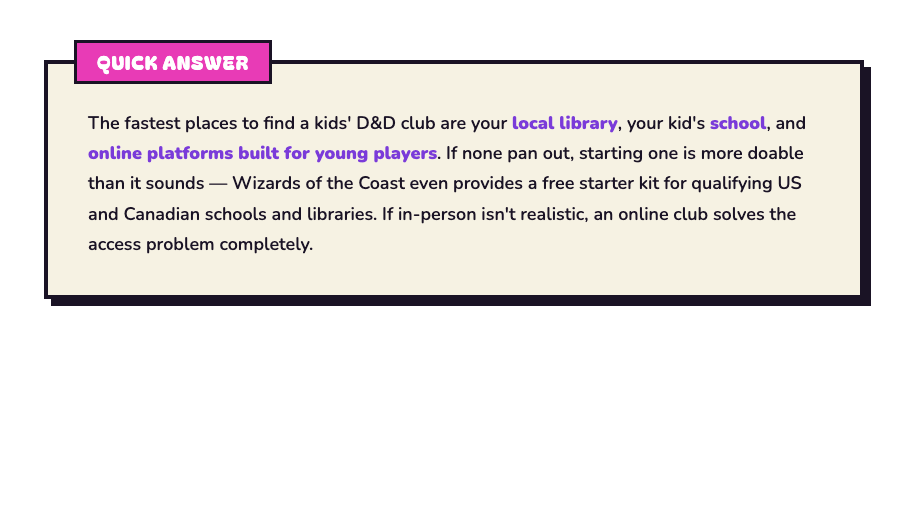
So your kid wants a D&D club. Where do you even start looking — and if there isn’t one nearby, is starting your own actually realistic? Let’s walk through both.
Where to Look First
1. Your local library. Libraries have quietly become one of the biggest hosts of kids’ D&D in the country. Many run age-specific groups — some split kids and teens into separate sessions. It costs nothing, and a librarian running the club has usually already solved the logistics you’d otherwise have to figure out yourself.
2. Your kid’s school. After-school D&D clubs have grown fast, often started by one teacher who plays casually. One real example: a middle school teacher expected maybe 10 kids to show up to a new club — 24 signed up. If your school doesn’t have one, that’s often a case of nobody having asked yet, not a lack of interest.
3. Online clubs and platforms. This is where it gets interesting for a packed schedule, no local option, or a kid who wants a consistent group instead of whoever shows up that week. Options range from casual Discord servers to fully structured platforms built for kids specifically — background-checked DMs, recorded sessions, no private messaging between kids and adults. See our full D&D for Kids guide for how online and in-person compare.
What a Good Club Actually Looks Like
Not every club is created equal. Whether it’s in-person or online, here’s what tends to separate a club that works from one that fizzles:
- Group size of 4–6 players per table. Bigger groups get chaotic fast and leave quieter kids with less airtime — experienced club-runners consistently land on this range.
- A consistent DM, not a rotating cast of whoever’s free that week.
- Short, rotating campaigns. Real-world school clubs found that capping campaigns at 2–3 sessions works better than one long story — it lets kids join or drop out between arcs without derailing the group.
- Visible turn order in combat. A detail almost nobody talks about: displaying whose turn is next — out loud or on screen — measurably helps neurodiverse players stay focused and engaged, according to teachers who run school clubs.
- A clear code of conduct. Things like: show up on time, ask before touching others’ materials, use encouraging language, accept setbacks gracefully. Simple, but it’s what keeps a club from falling apart when personalities clash.
Starting a Club If One Doesn’t Exist
This is more realistic than it sounds, and you don’t need to be a D&D expert to pull it off.
If you’re going the school or library route:
- Ask your school librarian, media specialist, or a teacher who might already play — clubs often start because one adult raises their hand, and there’s a good chance a colleague already plays.
- Apply for Wizards of the Coast’s D&D Afterschool Club Kit — free for qualifying US and Canadian schools, libraries, community centers, and camps.
- Look into the D&D Beyond Educator License, which gives qualifying schools and libraries free access to character-building tools and core rulebooks.
- Start small. One table, one DM, four to six kids. You can grow from there — just have a scaling plan ready, since clubs can outgrow expectations fast.
If in-person isn’t realistic for your family: an online club sidesteps almost every logistical headache — no driving, no scheduling around a single library’s hours. The tradeoff is being more deliberate about vetting: look for group minimums, recorded sessions, and background-checked adult DMs. Full checklist on our Safety page.
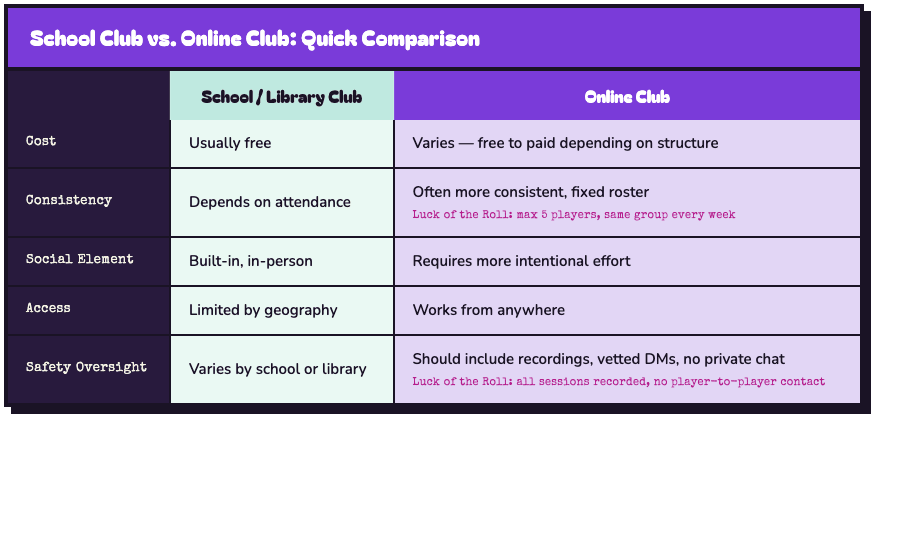
School Club vs. Online Club: Quick Comparison
| School/Library Club | Online Club | |
| Cost | Usually free | Varies — free to paid, depending on structure |
| Consistency | Depends on attendance | Often more consistent, fixed roster |
| Social element | Built-in, in-person | Requires more intentional effort |
| Access | Limited by geography | Works from anywhere |
| Safety oversight | Varies by school/library | Should include recordings, vetted DMs, no private chat |
Frequently Asked Questions
Is there an age cutoff for D&D clubs? Most clubs split by rough age band — commonly ages 10–13 and 13–17 — since a 10-year-old and a 16-year-old want pretty different things from the same game.
Do I need any D&D experience to start a school club? No. Free resources exist specifically so a non-expert adult can get a club running, including Wizards of the Coast’s Afterschool Club Kit.
How big should a club table be? Four to six players per DM tends to work best. One real school club grew to 24 students and had to split into four separate tables to keep it manageable.
Is an online club as social as an in-person one? It can be, especially with a consistent weekly group over several weeks — kids build real rapport with the same teammates session after session.
Is D&D club safe for my kid online? It should include recorded sessions, no private messaging between kids and DMs, and background-checked adults. See our full Safety guide before booking anything.
Can’t find a club that fits your kid’s schedule or age? Join the Luck of the Roll waitlist for structured online cohorts built specifically for kids 10–17.