
Your kid asked you about Dungeons & Dragons. Maybe it was after a Stranger Things binge. Maybe a friend mentioned a club at school. Maybe they just found a stack of dice somewhere and haven’t stopped talking about it since.
And now you’re here, Googling “dnd for kids,” because you have zero idea what this actually is, whether it’s safe, or whether your kid is about to disappear into a basement for the next four years.
Here’s something most guides won’t tell you: almost every D&D-for-kids article online is written for a parent who wants to run the game themselves. If that’s not you — if you’re looking for a place to send your kid — you’re about to get the guide nobody else wrote.
What Actually Is D&D?
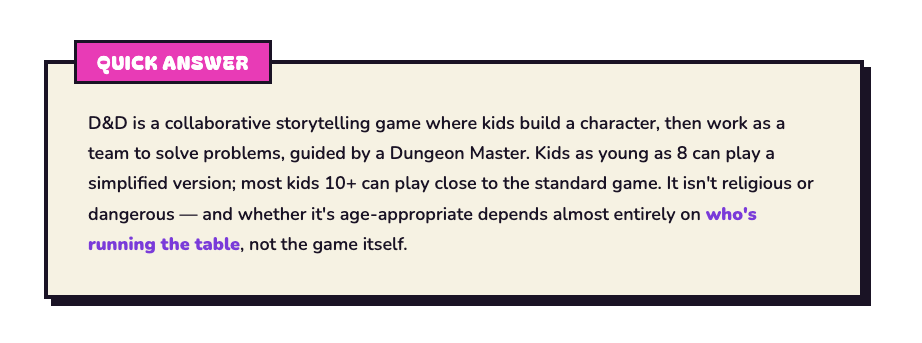
Strip away the dragons and the dice, and D&D is a structured version of make-believe. One person — the Dungeon Master, or DM — sets the scene and plays the world. Everyone else creates a character (a “sneaky rogue,” a “brave paladin,” whatever they want) and decides what that character does. Dice rolls determine whether risky actions succeed.
That’s it. There’s no board. There’s no way to “win.” The game just keeps going, session after session, building a story the group makes together.
Real result: every turn requires a kid to wait, listen, and build on what a teammate just said — a masterclass in patience and collaboration disguised as a game about slaying goblins.
How D&D Is Actually Played (A Real Walkthrough)
This is the part most parents are missing — and honestly, it’s the part that makes everything else click. Here’s what an actual session looks like, start to finish.
- Building a character (usually session one). Your kid picks a species (elf, dwarf, human — purely flavor) and a class (their “job”: Fighter, Wizard, Rogue, and so on — see our full D&D Classes Explained for Kids guide). They fill out a character sheet: a handful of numbers, a name, a look, maybe a one-line backstory. For a first-timer, this takes 15–20 minutes with help — more like a fun form than homework.
- The DM sets the scene. “You’re standing at the edge of a forest. The trees are unusually quiet.” Then: what do you do?
- Kids decide, dice decide the outcome. Want to sneak past a sleeping troll? Roll a d20 (the famous 20-sided die), add a small number from the character sheet, compare it to a target. High enough, success. Low, the troll wakes up. Every action — persuading a guard, swinging a sword, picking a lock — works the same way: describe it, roll it, find out.
- The story builds turn by turn. In combat, everyone takes turns in order. Outside combat, it’s looser — more like a conversation, with the DM narrating consequences.
- Nobody “wins.” The story just keeps going. Sessions end on a cliffhanger and pick back up next time — like episodes of a show your kid is co-writing.
Real consequence: that’s the whole mechanic, followable inside one session by any first-timer. Everything else — spells, subclasses, magic items — is depth to add later, not a barrier to entry now.
Is D&D Good for Kids? The Real Benefits
Parents searching this term usually want to know if D&D is doing something for their kid, or just a fun way to kill a Saturday. It’s both:
- Reading and math, constantly. Character sheets require basic arithmetic; every session is built on reading and interpreting text.
- Social-emotional skills. Taking turns, negotiating with teammates, handling a plan that fails — all practiced in a low-stakes, imaginative setting.
- Confidence for quieter kids. A shy kid can be bold as their character long before they’re ready to be bold as themselves.
- Real teamwork. The game only works if the group cooperates. Nobody wins alone.
Real result: DMs and parents consistently report more confidence, patience, and willingness to speak up in kids who play regularly — not a clinical outcome, just a pattern worth knowing about. D&D isn’t therapy, and it’s not a guaranteed fix for any specific challenge, so we won’t oversell it as one.
Is D&D Appropriate for Kids? (Addressing the Elephant in the Room)
If you’re old enough to be a parent right now, you might remember when D&D had a reputation problem. In the 1980s, a wave of concerned parents linked the game to Satanism and the occult — the so-called “satanic panic.” It made national news and scared a lot of families away from a game about pretending to be a wizard.
Some of that concern also focused on how absorbing the game could get — marathon sessions where kids lost track of time, meals, and sleep. That part is fair to take seriously (any hobby can be overdone), but it’s a scheduling and structure issue, not evidence the game itself is dangerous.
Who’s running the game matters more than the game itself. Every Dungeon Master decides what’s in their story, the same way an author decides what’s in their book. A DM can remove death from the game entirely. A DM can leave out dark themes, scary imagery, or mature content. That’s standard practice for anyone running games for young players — not a workaround.
The short version: D&D is a blank canvas. Age-appropriate D&D is a function of who’s running the table — not the game itself. Before booking anything, it’s worth knowing who your kid’s DM actually is, the same way you’d want to know who’s running any other activity they attend.
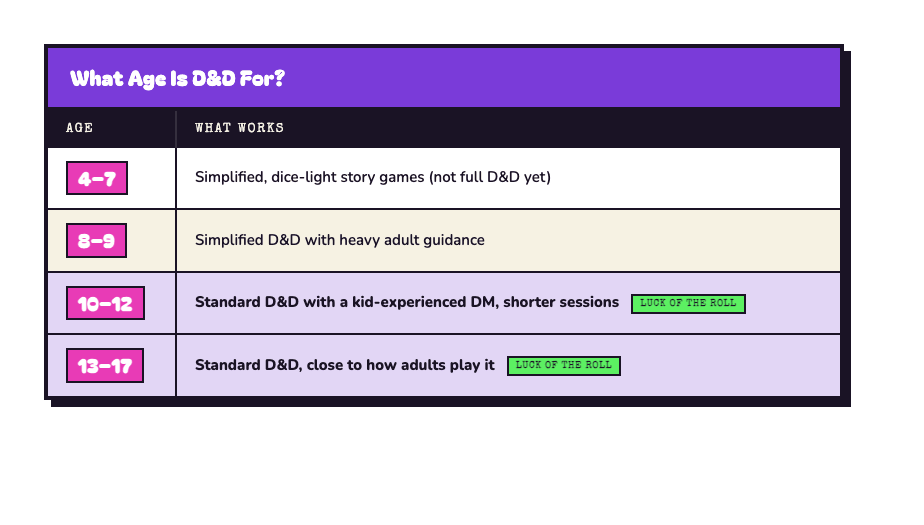
What Age Is D&D For?
| Age | What Works |
| 4–7 | Simplified, dice-light story games (not full D&D yet) |
| 8–9 | Simplified D&D with heavy adult guidance |
| 10–12 | Standard D&D with a kid-experienced DM, shorter sessions |
| 13–17 | Standard D&D, close to how adults play it |
Most experienced kids’ DMs land on 8 as the earliest realistic starting point, with 10 as the age a kid can typically manage a full character sheet without much help.
Online vs. In-Person: What’s Actually Different
In-person (school clubs, library groups, home games): free or low-cost, built-in social time, but scheduling depends on everyone’s availability and geography. See our full guide to finding or starting a D&D club.
Online (virtual classes, online clubs): access to experienced DMs regardless of location, easier to schedule around other activities, and — with the right platform — real safety infrastructure: background-checked DMs, recorded sessions, no private messaging between kids and adults. See our Safety page for exactly what to check before booking.
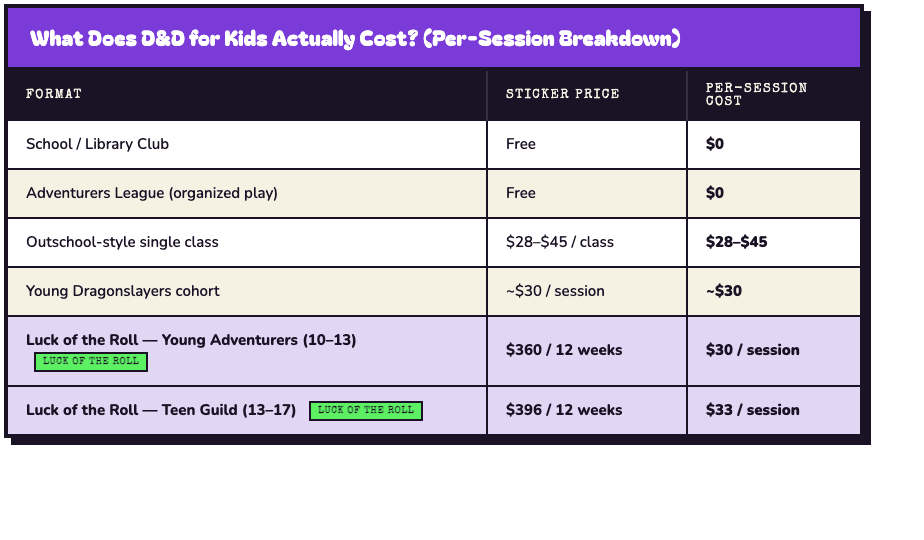
What Does It Cost? (The Real Per-Session Math)
Pricing varies a lot by format — and the sticker price alone doesn’t tell you much until you break it down to a per-session cost:
| Format | Sticker Price | Per-Session Cost |
| School/library club | Free | $0 |
| Adventurers League (organized play) | Free | $0 |
| Outschool-style single class | $28–$45/class | $28–$45 |
| Young Dragonslayers cohort | ~$30/session | ~$30 |
| Luck of the Roll — Young Adventurers (10–13) | $360 / 12 weeks | $30/session |
| Luck of the Roll — Teen Guild (13–17) | $396 / 12 weeks | $33/session |
Real result: a full 12-week Luck of the Roll cohort lands in the same per-session range as a single drop-in Outschool class — except with a consistent DM, a consistent small group, and 12 straight weeks of one ongoing story instead of a one-off.
How to Get Your Kid Started
- Check your library or school first. Many now run free D&D clubs, some seeded by Wizards of the Coast’s free D&D Afterschool Club Kit for qualifying US and Canadian schools, libraries, and community centers.
- Try an online class or club if there’s nothing local, your kid’s schedule is packed, or you want built-in safety features.
- Start with a starter set or a pre-made adventure if you want to run it yourself at home.
- Keep the first session short. 60–90 minutes is plenty for a first-timer.
Frequently Asked Questions
Is D&D religious or satanic? No. D&D is a fantasy storytelling game with no religious affiliation. The “satanic panic” association dates to unfounded 1980s claims with no credible evidence behind them.
What age is D&D appropriate for? Most experienced kids’ DMs start around age 8 with a simplified version, moving to standard D&D by 10–12. See the age table above, or our dedicated age-by-age breakdown for more detail.
What does my kid need to play? A character sheet, some dice, and imagination. Online play adds a device and a video call — nothing more specialized.
Is D&D just for boys? No — while roughly 60% of D&D players today are estimated to be male, the player base has shifted significantly, with girls now one of the fastest-growing groups at the table.
Do I need to know how to play to let my kid start? No. A Dungeon Master runs the game and teaches as they go.
How long does a session last? Adult games often run 3–4 hours. For kids, 60–90 minutes keeps attention and energy where they need to be.
Can my kid play D&D online safely? Yes, with the right setup: recorded sessions, no private DM-to-kid messaging, group minimums instead of 1-on-1s, and background-checked adult DMs. Full checklist on our Safety page.
How much does D&D for kids cost? Free through most school/library clubs; $28–$45 per class through platforms like Outschool; $360–$396 for a full 12-week structured cohort. See the pricing table above or our Cohorts page for current openings.
Ready to get your kid started the safe, structured way? Join the Luck of the Roll waitlist and be first in line when cohorts open.